
I've been on both sides of this question. I come from a background in databases, server administration, and application development — so when I decided to build my own freelance portfolio site, I thought it would be straightforward. It wasn't. The web has its own rules, its own traps, and its own thousand small decisions that nobody warns you about. And I've since watched clients make the same mistakes I almost made.
So let me give you an honest answer — not a sales pitch, not a tutorial. Just what I've learned from building sites and from working with people who tried to build theirs first.
The Illusion of "Anyone Can Do This Now"
Yes, AI tools and drag-and-drop builders have made it easier than ever to put something that looks like a website on the internet. And I won't pretend otherwise — a decent-looking landing page is genuinely within reach for a motivated beginner in 2025.
But a good-looking page is only one piece of the puzzle.
Getting it found in search engines is another. Making it fast is another. Securing it against the basic attacks that happen automatically to every public website is another. Setting up your DNS records, configuring SSL, understanding what your 42 installed WordPress plugins actually do — these are all separate skills, and most people don't realize they need them until something breaks.
I like to compare it to car repair. I've watched enough YouTube videos about engines that I understand the general idea. That doesn't mean I should rebuild a gearbox myself. At some point, watching and doing are very different things.
What a Professional Actually Brings
The real value of an experienced developer isn't the hours they spend working — it's the hours they've already spent suffering.
Every developer has a story about an eight-hour debugging session that turned out to be a single unoptimized image. Every developer has misconfigured something, locked themselves out of their own admin panel, or watched a site go down at the worst possible moment. Those painful experiences become instincts. They become the reason a professional never forgets to check certain things, never skips certain steps.
A DIY builder learns as they go, which is fine — unless they're also trying to run a business, meet a deadline, or launch something that actually needs to work.
There's also a category of knowledge most beginners don't know they're missing. SQL injection. Cookie compliance under EU law. Privacy policies and what they legally need to contain. Terms of service. Security for any page that accepts a login. These aren't advanced concepts — they're baseline requirements — but you don't know to look for them until someone tells you they exist.
The right tool for the right job also matters more than most people expect. A photographer's portfolio needs beautiful design and fast load times. A membership site with user accounts needs serious security. Treating these the same way — throwing the same template and the same stack at both — is a mistake that shows.
The Honest Decision Framework
Before you decide anything, ask yourself these questions:
- How important is this site, really? Is it a quick experiment, or is it genuinely meant to bring in clients or represent your work professionally?
- Do you plan to update it, grow it, and maintain it over time — or do you want it built and forgotten?
- How confident are you in your own ability to finish what you start, including the parts that get technical?
- Do you know what a hamburger menu is? Parallax scrolling? What the GDPR requires for cookie consent? If these terms are unfamiliar, that's useful information — not a reason to feel bad, just a signal about where you are right now.
I ask clients these questions not to steer them toward hiring me. I ask because the honest answers reveal what kind of project this actually is, and what kind of support it actually needs.
The Client Types I've Seen
Working with clients has taught me as much as building sites myself.
The best clients come prepared. Screenshots, reference links, a clear sense of what they want and why. Working with them is straightforward and the results are good.
The most difficult projects are the ones where the client isn't sure what they want — not because they're unreasonable, but because web design involves hundreds of subjective decisions that are hard to visualize in advance. Colors, typography, icon styles, menu structure. With software development, you can build 90% of something based on logic and experience, filling in gaps the client didn't think to mention. With a website, "I don't know, it just doesn't feel right" is a real and common response — and it's hard to build toward a feeling.
The hardest situation of all is inheriting someone's half-finished DIY project. Broken database structure, inconsistent code, plugins conflicting with each other, security holes baked into the foundation. Sometimes the most honest thing I can tell someone is that starting over would be faster and cheaper than fixing what's there.
When DIY Makes Sense
Building it yourself is a reasonable choice if you have time, patience, and at least some technical foundation to stand on. A simple landing page — one page, clear message, contact form — is genuinely manageable with modern tools, even with AI assistance.
But "manageable" has limits. A site with multiple pages, a blog, a booking system, user accounts, or any kind of e-commerce is a different project entirely. The complexity doesn't scale linearly. It compounds.
And then there's the timeline question. A clean, simple landing page can be done in three to seven days by someone who knows what they're doing. If a client asks me for something complex in the same timeframe, I don't take the job. That's not pessimism — that's experience.
The Old Joke on the Workshop Wall
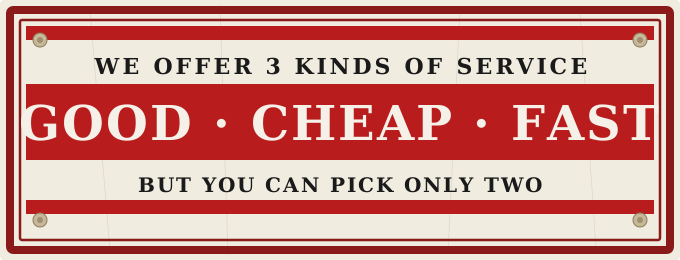
There's a sign I once saw in a car repair shop that I think about whenever someone asks me this question:
We offer three kinds of service: good, cheap, and fast. You can pick two.
It applies perfectly to websites.
- Good and fast won't be cheap.
- Good and cheap won't be fast.
- Fast and cheap probably won't be good.
Knowing which two matter most to you — and being honest about it — is the most useful place to start.
If you're genuinely unsure whether to hire someone, ask for a quote. Ask for ten quotes. It costs nothing and it gives you real information. You might be surprised what's possible within your budget, or you might realize the DIY route makes more sense for where you are right now.
Either way, going in with clear eyes is better than going in fast.